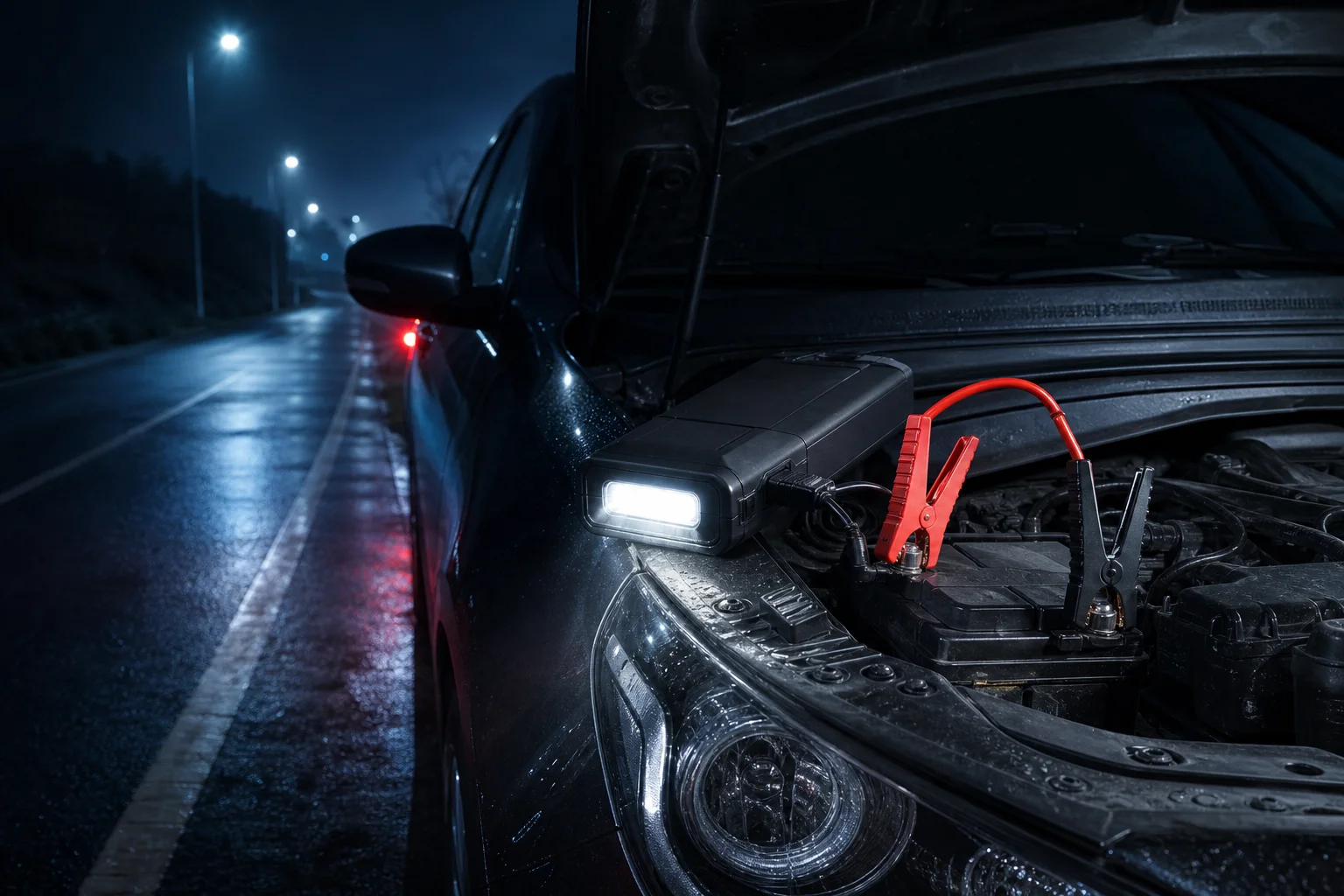
Jump Starter Buying Guide: How to Choose One That Actually Starts Your Car
What peak amps really mean, the safety features that matter, why a built-in tire inflator is worth it, and how to jump-start a car on your own in minutes.
DriveLux Editorial Team
Car tech guides and buying advice
A dead battery always shows up at the worst time: a dark parking lot, a cold morning, a car that sat for two weeks. Waiting for a stranger with cables or a roadside truck can take an hour or more.
A portable jump starter lets you fix it yourself in minutes. This guide covers what the specs actually mean, which features keep you safe, and how to use one the first time you need it.
01
The short answer
Quick answer
For most drivers, the PAIVIROKU 4-in-1 Jump Starter & Tire Inflator ($99.99) covers every common roadside problem in one case: it jump-starts 12V cars, SUVs and trucks, inflates tires up to 150 PSI with auto shut-off, charges your phone and lights up the scene. Smart clamps protect against wrong connections, so it is safe for first-time users.
02
Jump starter vs jumper cables vs roadside
Jumper cables only work if another driver stops to help. Roadside assistance works, but you wait on their schedule. A portable jump starter is the only option that puts you back in control.
| Feature | Jump starter | Jumper cables | Roadside call |
|---|---|---|---|
| Works without a second car | |||
| Typical time to get moving | Minutes | Depends on finding help | Often 30 to 90+ min |
| Inflates a low tire | Sometimes | ||
| Charges your phone | |||
| Protects against wrong clamp connection | N/A | ||
| Cost | One-time | One-time | Yearly fee or per call |
Roadside wait times vary by location and time of day.
03
Four tools in one case
The best modern jump starters do more than start a car. A 4-in-1 unit replaces four separate gadgets that would otherwise clutter your trunk.
Jump starter
Starts a 12V car, SUV or truck from its own battery. No donor car needed.
Tire inflator
Up to 150 PSI with a digital display. Set the pressure and it stops on its own.
Power bank
8000mAh battery with USB to keep your phone alive while you wait or drive.
Emergency light
Bright, strobe and SOS modes so you can see the engine bay and be seen.
04
What to look for in a jump starter
Made for your voltage
Almost every passenger car, SUV and pickup runs a 12V system. Confirm the unit is rated for 12V vehicles before anything else.
Smart safety clamps
Clamps with reverse-connection, short-circuit and overcharge protection are the single biggest safety feature, especially at night or in a hurry.
A built-in tire inflator
A slow leak is more common than a dead battery. An inflator with auto shut-off saves a second gadget and a trip to the gas station.
A capacity that does double duty
A larger battery (8000mAh and up) gives you room for a jump plus phone charging when you are stranded.
Recognised certifications
Look for FCC, CE, RoHS and UL markings. They show the unit has been tested, which matters for a lithium battery that lives in your car.
A case that keeps it together
Clamps, hose and adapters are easy to lose. A zippered case keeps the whole kit in one place in the trunk.
05
The specs, explained in plain English
Peak amps is the burst of power a unit can deliver for a split second. Brands measure it in different ways, so compare it loosely and never buy on that number alone.
mAh is battery capacity. More capacity means more jump attempts and more phone charging between recharges. PSI is the maximum pressure the inflator can reach. Most car tires need far less than 150 PSI, so a high rating simply means the pump is not straining.
Spec sheet
PAIVIROKU 4-in-1
- Peak current
- Up to 5000A
- Manufacturer rating
- Vehicle system
- 12V
- Cars, SUVs, trucks
- Battery
- 8000mAh
- Lithium polymer
- Air pump
- 150 PSI
- 20 L/min, auto stop
- Recharge time
- 4 to 5 hrs
- Top up every 3 months
- Weight
- About 3 lb
- 1.35 kg
06
Common buying mistakes
- Buying on peak amps alone. Peak figures are measured differently by every brand, so a bigger number on the box does not guarantee a stronger start. Safety features and a trusted build matter more.
- Choosing clamps without protection. Basic clamps will spark or short if you mix up the terminals in the dark.
- Letting it go flat in the trunk. A jump starter only helps if it is charged. Set a reminder to top it up every three months.
- Buying separate gadgets. A standalone inflator, power bank and flashlight take up more space and cost more than one 4-in-1 unit.
- Expecting it to fix a failed battery. A jump gets you started. If your battery dies again soon after, have it tested or replaced.
 Editor's pick
Our pick for most drivers
PAIVIROKU 4-in-1 Jump Starter & Tire Inflator
- Jump-starts 12V cars, SUVs and trucks without a second car
- 150 PSI inflator with digital display and auto shut-off
- 8000mAh power bank with USB phone charging
- LED light with bright, strobe and SOS modes
- Smart clamps with reverse-connection protection
- FCC, CE, RoHS and UL certified, with carry case
07
How to jump-start your car in 5 steps
- 1
Turn the car off along with the lights, heater and radio, and make sure the jump starter is charged.
- 2
Connect the red clamp to the positive (+) battery terminal, then the black clamp to the negative (-) terminal.
- 3
Switch the jump starter on and start the car as normal.
- 4
Once the engine is running, remove the black clamp first, then the red clamp, and switch the unit off.
- 5
Let the engine run or drive for a while so the alternator can recharge the car battery, then recharge the jump starter at home.
Always follow the jump starter user guide and your vehicle owner's manual. Some cars have dedicated jump points under the hood.
08
Keep it ready for the day you need it
Recharge every 3 months
Lithium batteries slowly lose charge in storage. A full recharge takes 4 to 5 hours, so do it overnight once a season.
Recharge after every use
A jump plus phone charging can use a lot of capacity. Top it up as soon as you are home so it is ready for next time.
Keep the kit together
Store the clamps, air hose and valve adapters in the case so nothing goes missing when you need it.
Check it before winter
Cold weather is when batteries fail most. Charge the unit and check your tire pressure as temperatures drop.
09
Frequently asked questions
Do I need another car to use a jump starter?
No. A portable jump starter has its own battery, so you can start your car on your own without a donor vehicle or jumper cables.
How many amps do I need in a jump starter?
Peak amp ratings are measured differently by each brand, so treat them as a rough guide. For everyday 12V cars, SUVs and trucks, focus on a unit rated for 12V vehicles with smart safety clamps. The PAIVIROKU is rated up to 5000A peak by its manufacturer.
Is it safe if I connect the clamps the wrong way?
With smart clamps, yes. The PAIVIROKU clamps protect against reverse connection, short circuits and overcharging.
Can a jump starter inflate tires?
Models with a built-in compressor can. The PAIVIROKU pumps up to 150 PSI, shows the pressure on a digital display and stops automatically at the pressure you set. Adapters for bikes and sports balls are included.
How often should I charge a jump starter?
Recharge it every 3 months in storage and after every use. A full charge takes 4 to 5 hours.
Is a jump starter a good gift?
It is one of the most practical gifts for new drivers, students, commuters and anyone in a cold climate. It ships free within the US with 30-day returns.
Never wait on the roadside again
Jump starter, tire inflator, power bank and light in one case. Free US shipping, tracked delivery and 30-day returns.
Building a full car safety kit? See which dash cam features protect you after an accident, or browse our car gifts under $50.
Keep reading
More from the Journal
 Exterior Upgrade
October 7, 2026 · 6 min read
LED Car Badge Guide: Sizing, Install and What to Know Before You Buy
How animated LED car badges work, how to measure for a flush 74mm or 82mm fit, waterproofing, installation, and the legal points every owner should check.
Read the guide Interior Organization
October 7, 2026 · 6 min read
Car Organizer Guide: How to Declutter Your Car for Good
A zone-by-zone system for a tidy car: what belongs on the visor, in the door and in the console, which organizers are worth it, and a 10-minute reset routine.
Read the guide Interior Comfort
October 7, 2026 · 5 min read
Car Mist Diffuser Guide: A Fresher Cabin Without Harsh Air Fresheners
How a car mist diffuser works, how it compares to vent clips and hanging fresheners, what to put in it, and how to use one safely on every drive.
Read the guide